
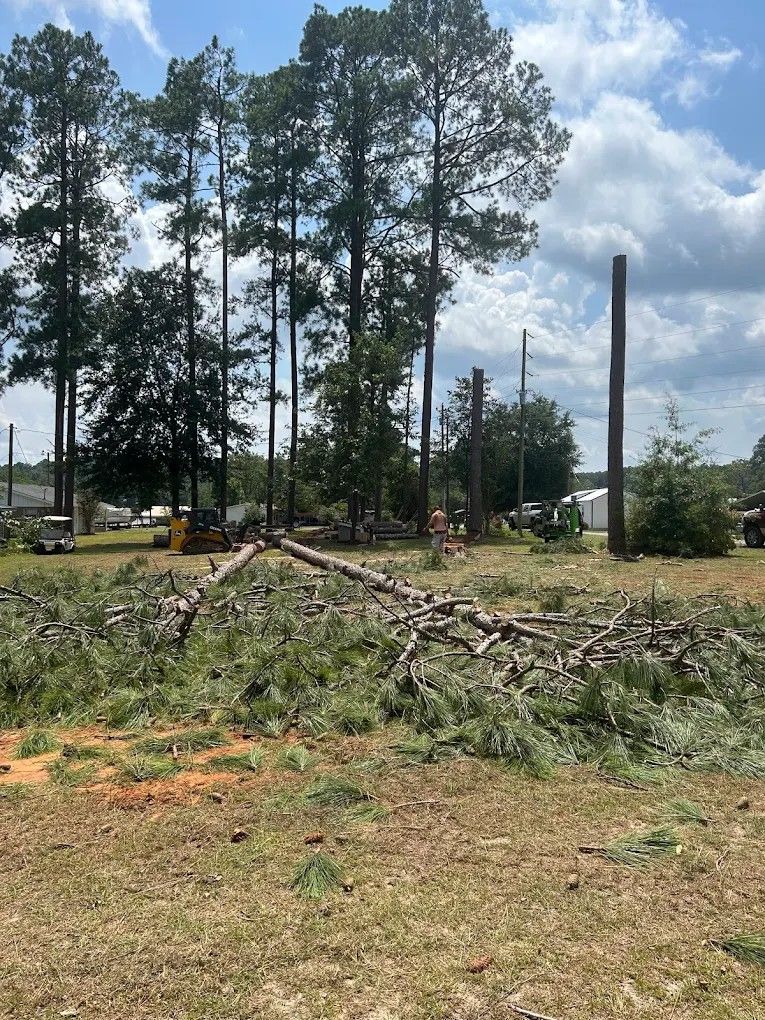
Eliminating Hazards Before Failure Occurs
Tree Removal in Chancellor for storm damage, structural instability, and property improvements
Dead trees lose bark integrity and branch attachment strength progressively, creating unpredictable failure points that send limbs through roofs or across power lines without warning during moderate wind events. Your property shows signs requiring removal when trunks develop hollow sections, root plates lift visibly after heavy rain, or canopies thin to less than twenty-five percent live foliage. Top Shelf Tree Services handles tree removal in Chancellor, Hartford, Dothan, and surrounding areas for residential and commercial sites dealing with specimens that trimming or treatment cannot salvage.
Removal requires rigging systems that control descent angles for sections weighing hundreds of pounds, crane positioning that accounts for overhead utility clearances, and stump grinding depth sufficient to allow lawn restoration or replanting without interference from remaining root mass. Diseased trees come down before fungal pathogens spread through root grafts to healthy adjacent specimens, and overcrowded plantings thin to restore growth space for preferred landscape trees.
Request a detailed estimate after an evaluation identifies which trees require removal versus corrective pruning.
What Happens After Problematic Trees Come Down
Planning begins with load calculations for rigging points, identifying drop zones clear of structures and plantings, and determining whether cranes access the site or if climbers dismantle the tree in sections from top down. Larger removals require traffic control when debris crosses public sidewalks, and utility companies receive notice before work begins near service lines running through canopies.
You notice immediate elimination of the hazard that prompted removal, restored sunlight reaching turf or garden beds previously shaded beyond recovery, and level ground where stumps formerly created mowing obstacles or tripping hazards across walkways. Properties gain usable yard space where root zones previously prevented construction of patios, sheds, or additions, and insurance inspectors remove tree-related concerns from reports that delayed policy renewals or sales closings.
Cleanup includes hauling all wood and debris off-site unless you request log sections retained for firewood, which requires cutting to specified lengths and stacking in designated areas. Stump grinding produces mulch that fills the resulting depression, though settling occurs over subsequent months as buried roots decompose and soil compacts.
Answers to Frequent Service Questions
Property owners considering removal often need clarity about what the process involves and how decisions get made when multiple trees show decline.
Top Shelf Tree Services coordinates removal timing with your project schedules when trees occupy areas planned for construction or landscape renovations. Schedule a property evaluation to determine which trees present safety concerns requiring action.
What makes a tree unsafe enough to require removal?
Trunk cracks extending through more than one-third of the diameter, root decay causing lean angles that increase annually, and canopy dieback exceeding fifty percent indicate structural failure risk that pruning cannot mitigate.
How does equipment avoid damaging surrounding landscape features?
Plywood sheets and ground mats distribute crane outrigger loads, rigging ropes thread through pulleys to lower sections vertically rather than allowing lateral swing, and hand-carrying methods protect areas too confined for machinery access.
When should removal happen versus waiting for better timing?
Storm-damaged trees with hanging sections require immediate attention, while trees declining from disease can often wait for dormant seasons when removal costs less and landscape impact decreases.
What determines removal cost differences between similar-sized trees?
Access difficulty, proximity to structures requiring precision rigging, disposal distance to dump sites, and whether utilities require temporary disconnection all affect pricing beyond simple trunk diameter measurements.
Why do some Chancellor properties need multiple removals in short timeframes?
Subdivision developments often planted fast-growing species simultaneously decades ago, causing coordinated decline as trees reach life expectancy, plus shared disease spread when roots graft underground between adjacent specimens.